
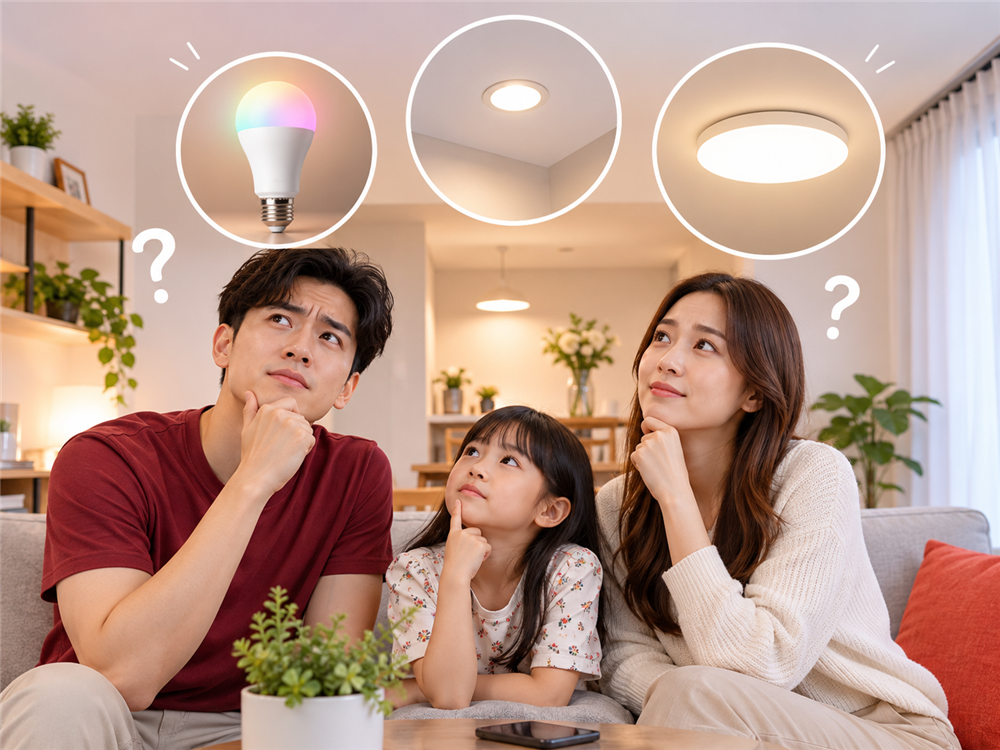
Light is the spirit of a house. Many homeowners are installing smart lighting, giving them greater control over their home's look and ambiance, letting them control lights by voice or phone, dim them, adjust colour temperature, and create different moods.
But choosing smart lighting can be tricky when it comes to space. Should you choose smart bulbs, smart downlights, or smart ceiling lights?
Why This Decision Matters
Smart lighting is not just technology. This means finding a solution that works for your house. Some of these types of lighting devices are easy to install and replace, while others may require more planning and installation.
Some can provide a comfortable ambiance, while others can be designed to light a whole space. Choosing the proper type from the outset saves you the cost and inconvenience of altering a fixture.
1. How easy is it to set up?
The simplest method is usually to install smart light bulbs. If you have the right fixture or lamp holder already, you can merely swap the old bulb for a smart light. So these devices are quite helpful for both homeowners and tenants who want to leave their lighting fixtures as they are.
Smart ceiling lights or downlights are usually a little more difficult to install. Ceiling lights are to be fixed to the existing ceiling unit, whereas downlights may need to be placed into the ceiling itself. It may require professional installation depending on construction.
2. What is the cost?
They tend to have the cheapest initial pricing because you can buy one bulb or two and then get additional later on. But if you want a lot of bulbs in your residence, this can be a greater expenditure overall.
Smart downlights may turn out to be costly because several units may be required, depending on the size of the room. Smart ceiling lights may cost more initially, but one single unit may do the job well enough. What is best for you depends on your requirements for illumination in addition to your needs for the lights.
3. What will it look like in your house?
Smart lighting is a great way to change the look of a room. Smart bulbs can be fitted into existing lamps and light fittings so the look is dictated by the fixture they’re in. If you like the lighting you already have, they are a versatile choice.
Smart downlights sit neatly in the ceiling, giving them a clean and basic look. They are perfect for modern designs where you want the lighting to disappear into the interior. Smart ceiling lights are more obvious and can be integrated into the design of the area. They come in a variety of shapes and styles that make them great for homeowners who want their primary light to add to the general decor of the room.
4. How well does light cover the area?
The smart lights are constructed differently to cast light differently. Smart lights are good for lamps and small spaces, but one bulb probably won’t cover a huge room. The amount of light coverage is also dependent on the bulb or fixture used.
Smart downlights produce more focused light. This makes them useful if you want to point light toward certain regions, but their placement has to be well thought out. Smart ceiling lights are designed to deliver a more even and widespread lighting throughout a room. That makes them a good choice for rooms such as bedrooms, living rooms, studies, and other areas that need general lighting.
5. How Much Control Does It Offer?
Smart lighting can be broken down into smart bulbs, downlights, and ceiling lights that come with smart controls according to their category. Depending on the model of the smart lighting, you may be able to alter the brightness, set the colour temperature, set lighting scenes, run routines through an app or a voice assistant, and many other things.
For lamps and accent lighting, smart bulbs work best. In case of the need to make separate lighting areas in one room, smart downlights should be used. Only one major fixture changing over the day may require the use of smart ceiling lights.
6. How well does it interact with your home setup?
It's a good idea to evaluate how smart lighting will integrate with your current system before you make a purchase. Smart lights typically require constant electricity to maintain a connection and listen for directions. If the wall switch is turned off, the light can become disconnected and unavailable for app or voice control.
Also be sure to check your Wi-Fi coverage, the sort of connection necessary, and that it is compatible with the smart home platform or app you already use. If you're installing more than one smart light, it is also important to think about how they're going to link and interact with each other.
7. Which Is Better for the Future?
Think of how your house may look in the future. Smart bulbs are easy to replace and transfer, making them a good option for renters, those who move around a lot, or anybody who wants to enhance their lighting over time.
Ceiling lights and smart downlights are more durable. These are better suited for homeowners who are designing a long-term lighting system, building or remodelling a new home. You can mix types too. You can, for example, have smart ceiling lights as main lights, smart downlights for certain areas, and smart bulbs in table or floor lamps.
Conclusion
In short, your choice comes down to your space and goals: pick smart bulbs for cheap and easy setup, smart downlights for a modern, focused look, or smart ceiling lights for bright, full-room light. Feel free to mix and match to fit your home!